
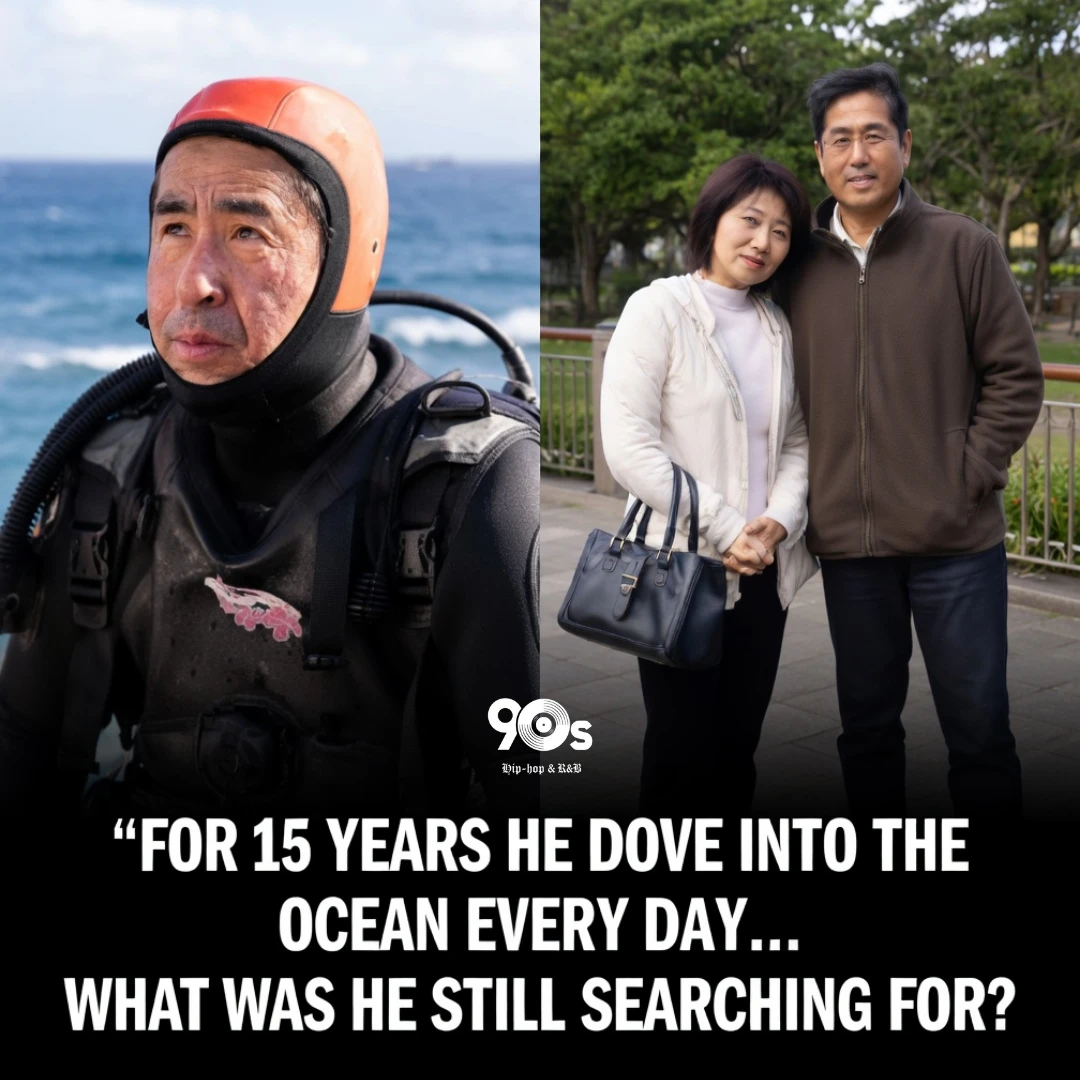
The Man Who Still Dives for Love: A Husband’s 15-Year Search Beneath Japan’s Cold Sea
In the icy waters off Japan’s northeastern coast, an elderly man quietly prepares his diving gear. The ocean stretches endlessly before him, gray and silent. For most people, these waters are simply part of the vast Pacific.
For Yasuo Takamatsu, they are the last place his wife might be waiting.
More than fifteen years have passed since the devastating 2011 Tōhoku Earthquake and Tsunami tore through Japan’s northeastern coastline. Entire towns were swallowed by towering waves. Nearly 20,000 people lost their lives, and thousands were never found.
Among the missing was Takamatsu’s wife, Yuko.
And ever since that day, he has refused to stop looking for her.
On March 11, 2011, life in the quiet coastal town of Onagawa seemed ordinary.
That morning, Takamatsu dropped his wife off at work. She worked at a local bank branch near the waterfront. Like countless couples everywhere, they expected to see each other again that evening.
But at 2:46 p.m., everything changed.
A massive earthquake—one of the strongest ever recorded—struck off Japan’s coast. Minutes later, a towering tsunami surged toward towns along the Tōhoku region.
The waves were unstoppable.
Buildings collapsed. Entire neighborhoods vanished. Cars, boats, and people were swept into the sea.
At the bank where Yuko worked, employees scrambled to escape. Some tried to reach the roof as the water rose.
Some never made it.
Later, rescuers found Yuko’s phone in a parking lot near the bank. On it was a message she had sent to her husband shortly before the tsunami struck.
It read:
“Are you okay? I want to go home.”
Those words would become the final message Takamatsu ever received from his wife.
In the weeks after the disaster, Takamatsu searched desperately for answers.
He walked through destroyed neighborhoods.
He combed beaches littered with debris.
He looked through forests, mountains, and evacuation areas.
But there was no trace of Yuko.
Thousands of families across northeastern Japan were facing the same agony—waiting, hoping, searching.
After more than two years of looking on land, Takamatsu realized something painful.
If his wife had been carried away by the tsunami, the sea might be the only place left to search.
Takamatsu had never been a diver.
He was a bus driver by profession, not an athlete or ocean explorer. The idea of scuba diving in the cold Pacific waters was intimidating.
But grief has a way of changing people.
In 2013, he made a life-altering decision: he would learn to dive.
Not as a hobby.
As a mission.
He earned his scuba certification and began descending into the murky waters of Onagawa Bay, hoping that somewhere beneath the waves he might find a trace of his wife.
The water was cold. Visibility was poor. The seabed was filled with wreckage carried out by the tsunami.
Still, he continued.
Again and again.
Over the years, Takamatsu has descended into the ocean hundreds of times—more than 650 dives in total.
Nearly every weekend, he pulls on his heavy diving suit, straps on oxygen tanks, and steps into the sea.
The dives are physically demanding, especially as he grows older. The cold water bites through protective layers, and currents make the search difficult.
But Takamatsu keeps going.
Sometimes he finds objects that once belonged to other victims—photographs, clothing, pieces of everyday life lost in the disaster.
When he does, he helps return them to families who are still mourning.
Yet despite all those dives, he has never found his wife.
Takamatsu is now nearing 70 years old.
Age has made diving harder. His body cannot endure the same physical strain as before. Some weekends he must rest instead of entering the water.
But the search has never truly stopped.
For him, every dive is more than an act of hope.
It is a promise.
“I dive like I’m going to see her,” he once said.
In his mind, Yuko is still somewhere beneath the waves—waiting for someone who loves her to bring her home.
Over time, Takamatsu’s quiet mission has become something larger than a personal tragedy.
Across Japan, people have come to see his journey as a symbol of unwavering devotion.
In a culture that values perseverance and loyalty, his story reflects a deeply human truth: some promises are too important to abandon.
Even when the chances seem impossibly small.
Even when years pass.
Even when the ocean is vast.
Standing at the edge of the sea, Takamatsu understands the reality.
He knows the odds of finding his wife are extremely slim.
But giving up would mean something worse.
It would mean leaving her alone.
So he keeps diving.
Because somewhere in his memory, the message still echoes across time:
“Are you okay? I want to go home.”
And as long as he can still step into the ocean, Yasuo Takamatsu believes there is only one answer he can give.
He is still trying to bring her there.